AAC-ELD, AAC-LD

Fraunhofer Institute for Integrated Circuits

AAC-ELD, AAC-LD

Overview

AAC-ELD Logo

Low Delay AAC (AAC-LD) and its successor, Enhanced Low Delay AAC (AAC-ELD), are state-of-the-art MPEG-4 audio codecs for maximum speech and audio quality at very low coding delay. The codecs are designed for high-quality IP-communication applications and devices. AAC-LD is derived from MPEG AAC-LC, while AAC-ELD is a combination of MPEG AAC-LD and Spectral Band Replication (SBR).

QualityAAC-LD: CD-like audio quality at full audio bandwidth and superior to ITU-T G.722/G.722.1-C, G.729.1 at identical bit-rates
AAC-ELD: CD-like audio quality at full audio bandwidth
Bitrates
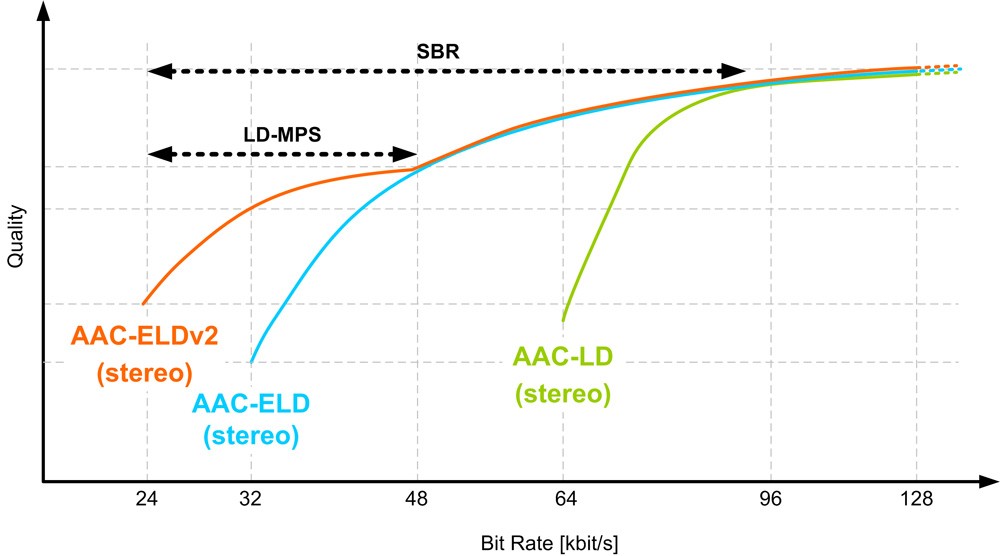
AAC-LD: Large range of bit-rates (32 kbit/s - 64 kbit/s and more)
AAC-ELD:
optimized for bit-rates from 24 to 64 kbit/s and more
 
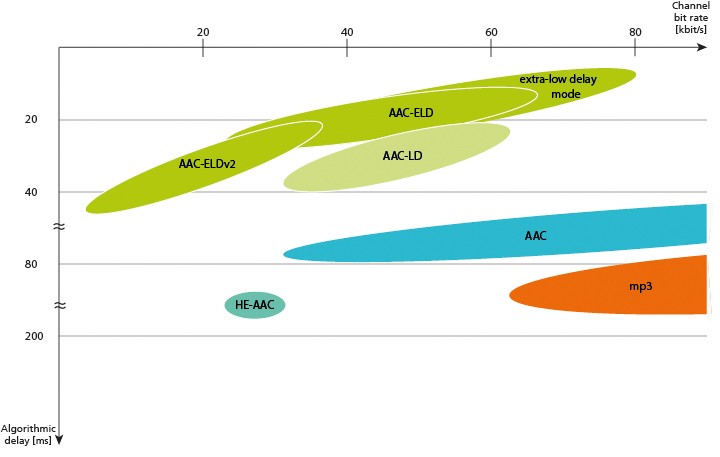
Algorithmic delayAAC-LD: down to 20 ms
AAC-ELD: down to 15 ms at 64 kbit/s, and up to 32 ms at 24 kbit/s
Channelsmono, stereo, multi-channel
Used ine.g. Cisco TelePresence, Telos Zephyr/IP, Comrex Access, Codian MCUs, Texas Instruments VoIP HD Voice Platform, Digigram
Special featureSuitable for all kinds of audio signals, including speech, music and ambience


Applications

AAC-LD and AAC-ELD are the perfect choices for any delay-critical application that requires full audio bandwidth at low data rates down to 24 kbit/s. The codecs are designed to improve the overall audio quality of any communication application, such as next generation video and teleconferencing or voice-over-IP systems, as well as broadcasting equipment.

AAC-LD audio codecs have been deployed in many telephone and videoconference systems including those from global suppliers such as Cisco, Tandberg and others. It has been licensed for the VoIP-DSP solution from Texas Instruments Inc., while Apple Computer has selected it for iChat, its Mac-based VoIP application.

AAC-LD is an attractive extension for cordless telephone devices. It has been standardized in the ETSI Dect Group as the only super-wide-band communication codec for CAT-iq.

AAC-ELD is already used in broadcasting gateways such as the Zephyr/IP transceiver from Telos, and in devices from Comrex.

Application Scenarios

(Mobile) Voice over IP Services

AAC-(E)LD enables operator of 3G and especially 4G (LTE and WiMax) networks, cable operators, Internet service providers and telecommunications companies to offer highly differentiated, CD-quality phone services. Using the latest high-quality perceptual MPEG audio codecs, voice, sounds and music are accurately reproduced, allowing rich, natural and productive communication far superior to anything used in phone services today. This allows the rollout of advanced Voice over IP (VoIP) services with minimal effort, be it for cable VoIP, FTTH, IPTV, mobile or Internet communications.

Video- and Teleconferencing

Today’s users of video- and teleconference systems expect superb audio quality with no compromises in usability and utility. By employing AAC-(E)LD, manufacturers of video- and teleconferencing systems, devices and software can deliver CD-like quality. This leads to a natural and appealing communication experience. AAC-LD audio codecs have been deployed in many telephone and videoconference systems, including those from leading suppliers such as Cisco and Tandberg.

Telepresence at Home

Globalisation is having a profound effect on individuals’ business and private lives. The changing patterns of work and life are leading to a greater need for high-quality, easy-to-use personal communication solutions that allow people to keep in touch with friends, family and colleagues. The audio codecs AAC-(E)LD can provide the basis for comprehensive solutions integrated into broadband connected devices, including PCs, TVs, set-top boxes and mobile phones. Staying in touch should be as natural as having a conversation with all participants present in the same room. Fraunhofer’s low delay audio codecs allow service providers and hardware manufacturers to make this a reality.

Broadcast Contribution

Live reports from remote locations have historically relied on QoS-proven ISDN network connections. ISDN is being replaced, however, by Internet connections and, even less reliably, mobile and stationary wireless links. This represents a major challenge for broadcast equipment manufacturers as IP-networks are best-effort-networks that do not support guaranteed bit-rates or constant delays. AAC(E)LD provides the necessary low bit-rates down to 24 kbit/s and high-quality error concealment to address these issues. It is therefore an ideal component of broadcast contribution products. For example, Telos has implemented AAC-LD in its acclaimed Zephyr/IP codec.


Availability

Fraunhofer IIS is the leading independent provider of optimized AAC-(E)LD implementations. Encoder and decoder object and source code are available immediately for:

  • PC (Win/MacOS X/Linux)
  • Power PC processors
  • TI C64, OMAP, DaVinci
  • ARM
  • MIPS
  • Freescale 563xx (through third party)
  • ADI Blackfin
  • Starcore, TI C55 and Freescale Coldfire (only source code)
  • Apple iPhone® SDK 

For a quick overview, the pdf file below provides a summary of our product offering:

Preisanfrage
Patent licensing:
A patent licensing program is administered by Via Licensing Corporation. Please visit www.vialicensing.com  for more information or contact info@vialicensing.com.


Audio Quality and Delay

AAC-ELD is the superior, best-in-class codec for communication solutions requiring excellent audio quality at low bit-rates and with minimal latency.

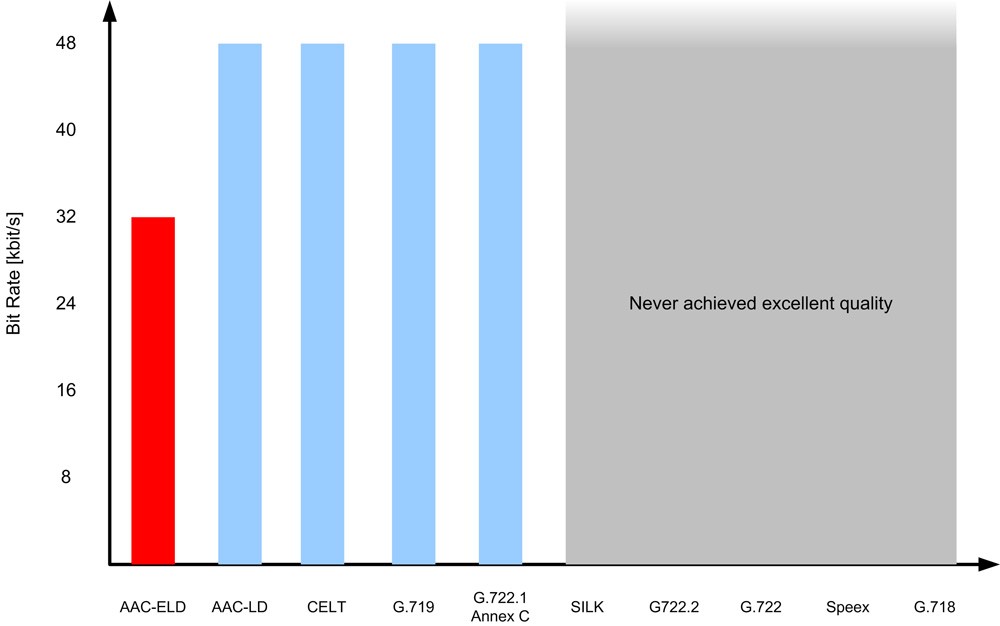
AAC-ELD has been evaluated in several independent tests comparing it to codecs like G.718, G.719, G.722.1 Annex C (Siren 14), G.722.2 (AMR-WB), G.722, Silk, Speex and CELT. In these tests, AAC-ELD was found to deliver excellent quality at lower bit-rates than any of its competitors.

Results can for example be found in:

AAC-ELD is the perfect choice for high-quality VoIP communication applications over fixed as well as mobile networks, because it offers

  • High quality audio for natural communication experiences
    Unlike traditional communication codecs, the AAC-ELD full band audio codec ensures superb audio quality for speech, music and background sounds. Compared to any super wide band or full band codec (including for example Siren 14, G.719, G.718), AAC-ELD facilitates superior audio quality at 32 kbit/s for all the above signal types and enables excellent audio quality and versatility.
  • Low delay – essential for productive real-time communication
    AAC-ELD delivers its superb audio quality at an algorithmic delay down to 15 ms. Other codecs, such as Siren 14, exhibit almost three times the algorithmic delay1 . A low delay allows a completely natural communications flow.
  • Low bit-rates – valuable bandwidth saving
    AAC-ELD operates at bit-rates as low as 32 kbit/s. Accordingly, the codec needs only 70% of the bit-rate required by for example Siren 14 and CELT to deliver the same audio quality.
  • Intelligible conversations even under adverse network conditions
    AAC-ELD addresses packet loss caused by adverse network conditions with a superior error concealment technology. Unlike other comparable codecs, it provides good intelligibility at packet loss rates of up to 33%.  
  • Multi-channel support for a real face-to-face communication experiences
    In contrast to other super wide band audio codecs - for example Siren 14 or Silk - AAC-ELD supports efficient coding of stereo and multi-channel signals to address spatial communications requirements found for example in telepresence systems. The result are conversations that feel as natural as if all the participants were talking to each other in the same room.
  • No additional patent royalties
    Licensees of the AAC Joint Patent License can implement and sell products using AAC-ELD and AAC-LD at no additional patent royalty cost, as the Joint Patent License covers all members of the AAC codec family. Visit www.vialicensing.com for more information.

Background Information

Contemporary perceptual audio codecs such as MPEG Layer 3 (mp3) and MPEG-4 AAC offer good audio quality at bit-rates down to 24 kbit/s. However, the algorithmic delay of the encoder/decoder chain exceeds 100 ms and is therefore not acceptable for two-way communication. By way of contrast, low delay speech coding schemes such as G.729 only provide satisfactory quality for speech signals and usually fail when used for complex audio signals like music.

The low delay audio codecs AAC-LD and AAC-ELD by Fraunhofer IIS are designed to combine the advantages of perceptual audio coding with the low delay necessary for two-way communication. They bridge the gap between speech coding schemes and high quality audio coding schemes. Thus, the codecs have achieved wide acceptance in high end video conference terminals and is used in professional broadcasting applications.

Unlike common speech coders, the achieved coding quality of AAC-LD and AAC-ELD scales up with bit-rate, and transparent quality can be achieved. The audio quality of AAC-LD is superior to ITU-T G.722/G.722.1-C, G.729.1 at identical bit-rates. A structural comparison with the ITU-T pendant G.722.1-C (Siren 14) is discussed in the AES paper "Structural analysis of low latency audio coding schemes" and is available on request.

1 Structural analysis of low latency audio coding schemes; Lutzky, Manfred; Schmidt, Markus; Geiger, Ralf; 119th Audio Engineering Society; download convention paper here


Videos

A typical day in our AAC world

Co-developed by Fraunhofer IIS, the AAC audio codec family enables today's media world.


A technological revolution from Fraunhofer IIS

With the Fraunhofer Audio Communication Engine you can't beam people into your living room, but you can talk to them as if they were really there however far away they might be.


Fraunhofer IIS at Mobile World Congress 2010

Fraunhofer Audio Communication Engine for world's first CD quality mobile phone calls over a LTE-A network at Mobile World Congress 2010.


Demo

Acoustic Echo Control


Error Concealment Technology


High-quality low delay audio codec


Related press releases