Contents of trainee programs
Analog IC Design
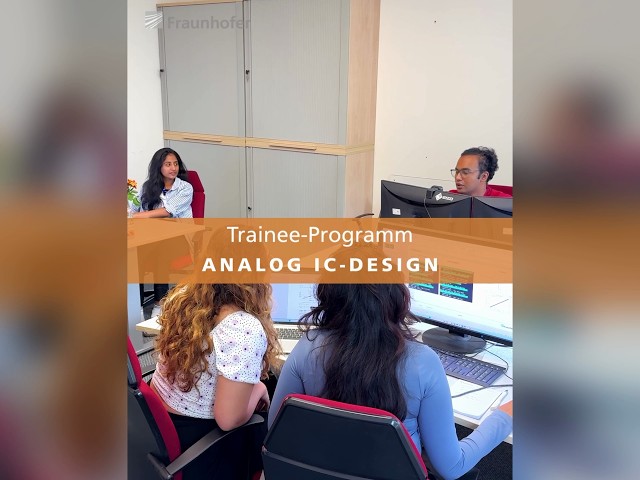
The Analog IC Design Trainee Program provides participants with a comprehensive introduction to the development of analog integrated circuits. Under the guidance of experienced engineers, trainees work on real-world development projects and gain hands-on experience in circuit design, simulation, layout, and verification of analog ICs.
A particular focus is placed on the development and optimization of circuits with regard to power consumption, speed, robustness, and area efficiency.
The trainee program offers three specialization tracks:
- Classic Analog IC Design – Fundamentals and methodologies of conventional analog circuit design
- RF Integrated Circuit Design (RFIC) – Design and development of integrated high-frequency circuits for modern communication and sensor systems
- Mixed-Signal IC Design for RF Integrated Circuits (RFIC) – Combining analog and digital circuit concepts for modern RFIC applications
Digital IC Design
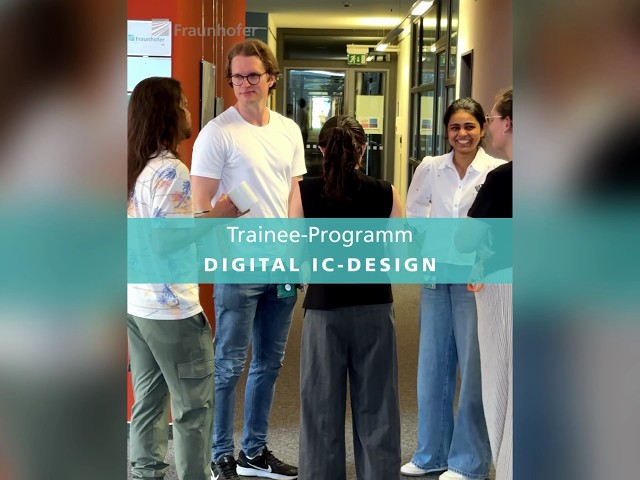
Trainees on the Digital IC Design trainee program receive a comprehensive introduction to the front-end design of digital integrated circuits. You will work on real projects under the guidance of experienced engineers and gain practical experience in the modeling, simulation, synthesis and functional verification of digital systems.
A particular focus is on the application of hardware description languages such as Verilog and VHDL as well as an in-depth understanding of modern processor architectures, e.g. RISC-V. The aim is to efficiently analyze and optimize digital circuits in terms of performance, resource consumption and timing. In addition, there is the opportunity to work with other trainee teams such as Analog IC Design and System Engineering, which fosters a collaborative working environment and provides insights into various aspects of semiconductor design and system integration.
Test and Validation
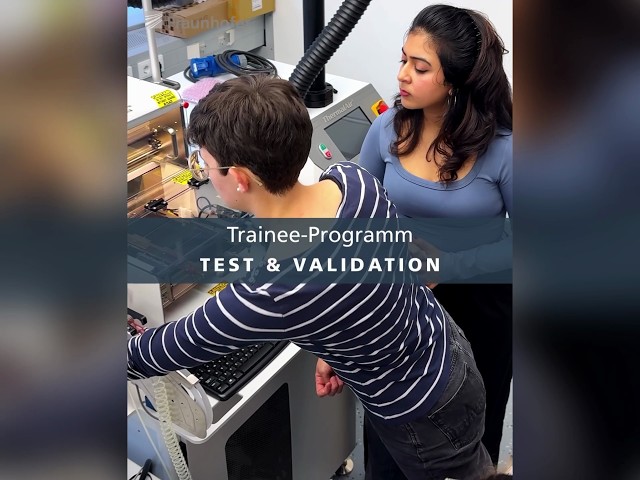
Our Test and Validation trainee programme provides a comprehensive introduction to the characterization and testing of integrated circuits. The trainees work on real projects under the guidance of experienced engineers. Practical experience is gained in the use of state-of-the-art test equipment and methods, test setups (PCB, test code, etc.) are developed and the reliability and quality of IC product testing is prepared and ensured.
In addition, there is the opportunity to work with other teams such as IC design and product management, which fosters a collaborative working environment and provides insights into various aspects of semiconductor design.
System Engineering
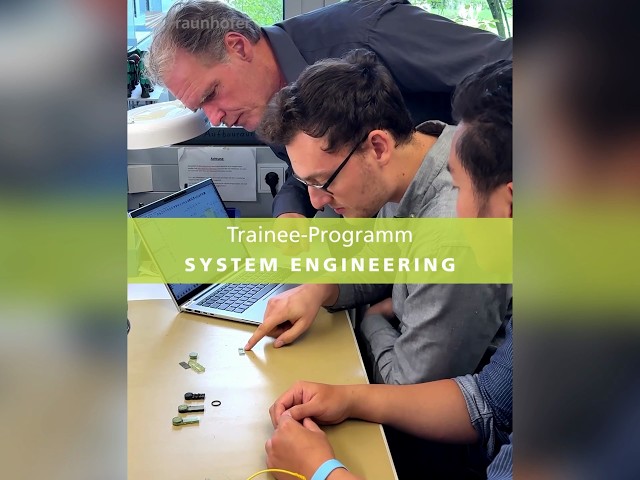
Trainees on the System Engineering trainee program receive a comprehensive introduction to the system architecture and integration of chiplet-based systems. They work on real projects under the guidance of experienced engineers and gain practical experience in the specification, partitioning, co-design and verification of heterogeneously integrated systems.
In addition, there is the opportunity to work with interdisciplinary teams from IC design, packaging, test and product management, which fosters a collaborative working environment and provides valuable insights into various aspects of modern semiconductor systems and their manufacturing processes.
 Fraunhofer Institute for Integrated Circuits IIS